
Public quantum network: The first node
We present a quantum network that distributes entangled photons between the University of Illinois Urbana-Champaign and a public library in Urbana. The network allows members of the public to perform measurements on the photons. We describe its design and implementation and outreach based on the network. Over 400 instances of public interaction have been logged with the system since it was launched in November 2023.
Topics
Telecommunication networks, Single-photon detector, Optical fibers, Beam splitter,Parametric down conversion, Photonic entanglement, Polarization, Waveplate, Local realism,Quantum information
Expanding access to technologies can enable leaps in innovation and substantial broadening of applications, as demonstrated by the evolution of the cell phone. Quantum technology based on superposition and entanglement could similarly benefit from individuals being able to “play” with the technology. There have been public applications of quantum networks such as the Big Bell Test,1quantum secure voting in Chicago,2 a quantum secure smartphone,3 and utilizing public fibers with industry partners at Oak Ridge National Laboratory to create a commercial quantum network.4 Most current quantum networks have been developed largely without a public-facing aspect.5 We are building a quantum network in which the public can “play” with network hardware settings in order to engage the public in exploring the potential of the technology and discovering new use cases. The network also allows us to perform quantum network research in real-world environments.
The publicly accessible quantum network we are building, which we call the Public Quantum Network (PQN), connects our laboratory at the University of Illinois Urbana-Champaign (UIUC) to a publicly accessible node at The Urbana Free Library (TUFL) in downtown Urbana, IL. At the library, members of the public explore an interactive exhibit, which provides a brief history of the development of quantum technology since the early 20th century and introduces superposition, entanglement, and measurement on the network. The exhibit culminates in a Clauser-Horne-Shimony-Holt (CHSH) inequality experiment using pairs of entangled photons created in our lab at UIUC and distributed to the library. Library visitors can choose which polarization bases to measure the photons in, allowing them to verify the existence of entanglement for themselves.6 Whereas these quantum concepts are typically first discussed in senior undergraduate physics classes, the PQN aims to make these topics accessible in a hands-on way to anyone interested in exploring them. TUFL visitors have interacted with the CHSH measurement station over 400 times since the PQN launch in November 2023. With the TUFL node as a model, we hope to extend the PQN by implementing future nodes in libraries, museums, and schools, thereby providing opportunities for the public to interact hands-on with quantum technology and participate in its development.
The PQN currently comprises two network nodes, as shown in Fig. 1: one at the Loomis Laboratory of Physics (Loomis) on the UIUC campus and the other at TUFL. These nodes are connected by two strands of dark (i.e., unused) optical fiber, forming a loop with a 12-dB loss over the 24-km round trip distance. The optical fiber link is provided by Urbana-Champaign Big Broadband, a not-for-profit organization run in collaboration by the University of Illinois and the cities of Urbana and Champaign through the company i3 Broadband. Entangled photon pairs from a source at Loomis are distributed such that one photon from each pair remains at Loomis, and the other travels through fiber to the library and back. The photon that remains at the lab is projected using a half-waveplate and polarizing beam splitter before being collected into fiber and detected on a superconducting nanowire single-photon detector (SNSPD). The other photon is sent to the public library via the dark fiber link, launched into free space to be projected based on users’ input, and sent back through fiber to the lab to be detected on a SNSPD. The coincidences, the simultaneous detection of photons at different detectors, are analyzed using a time-tagger.
More: https://pubs.aip.org/aip/apl/article/126/5/054002/3333903/Public-quantum-network-The-first-node
Quantum mechanics, classical backbone: DARPA’s QuANET advances practical quantum networking
Can the strengths of classical and quantum communications be combined to create a resilient and secure networking infrastructure? This is the challenge that DARPA is tackling through its Quantum-Augmented Network (QuANET) program. So far, signs point to yes.
Quantum networking offers the potential for private, secure and resilient high-speed information exchange. But until now, it’s required specialized and isolated systems, making it difficult for researchers to experiment, iterate, and scale. QuANET is addressing this challenge by integrating quantum links into classical communications infrastructure. By doing so, the program is creating a more accessible, integrated network – one that could eventually support secure global communication, collaborative research, and real-time verification.
Just 10 months into the program, QuANET performers gathered for a cross-team hackathon and demonstrated the first functioning quantum-augmented network. Using both classical and quantum links, messages were transmitted across the entire network without interruption.
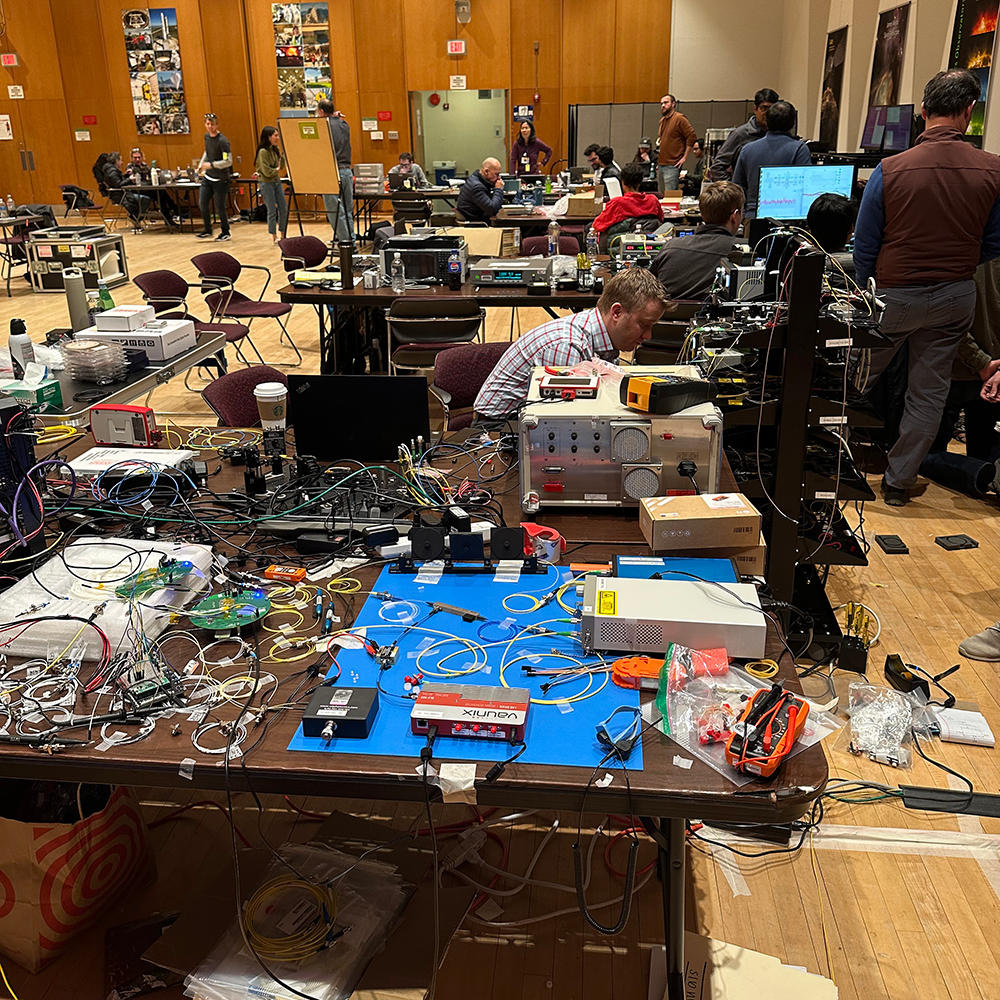
QuANET performers participated in a cross-team hackathon. Source: Oliver Slattery
On one link, messages were encoded onto squeezed light, which is a quantum state of light that can enhance precision for certain measurements. Researchers transmitted encoded data, including images of the DARPA logo, a QuANET event graphic, and an ascii cat. The initial transmission took five minutes, but through real-time optimization, subsequent attempts reduced the time to a never-before-achieved 0.7 milliseconds, or a bit rate of 6.8 Mbps – enough to stream high-definition video.
QuANET researchers are also working toward deploying hyperentangled photons – particles of light that are entangled in multiple independent quantum properties at once, allowing each to carry much more information – into a data packet transmission. This technique allows more data to be sent simultaneously, improving the efficiency of communication. It also enhances the privacy and security of the network by making it harder to intercept or tamper with the data without detection.
More: https://www.darpa.mil/news/2025/quanet-advances-practical-quantum-networking
Quantum Internet Breakthrough: Scientists Build Scalable Network Node With Light and Ions
The new interface paves the way for connecting quantum devices.
Quantum networks are often described as the next stage of the internet. Instead of transferring ordinary digital information in bits, they use photons to carry quantum information. This approach could make communication virtually unbreakable, connect faraway quantum computers into one powerful system, and enable sensing technologies capable of measuring time and environmental conditions with extraordinary precision.
For this kind of network to work, researchers must develop quantum network nodes that can both store quantum information and exchange it through light particles. In a recent breakthrough, a team led by Ben Lanyon at the Department of Experimental Physics, University of Innsbruck, demonstrated such a node by using a chain of ten calcium ions inside a prototype quantum computer.
By finely controlling electric fields, the scientists guided the ions one at a time into an optical cavity. Inside the cavity, a carefully calibrated laser pulse caused each ion to emit a single photon, with the photon’s polarization becoming entangled with the ion’s quantum state.
Linking Ions and Photons
The process created a stream of photons; each tied to a different ion-qubit in the register. In future the photons could travel to distant nodes and be used to establish entanglement between separate quantum devices. The researchers achieved an average ion–photon entanglement fidelity of 92 percent, a level of precision that underscores the robustness of their method.
“One of the key strengths of this technique is its scalability,” says Ben Lanyon. “While earlier experiments managed to link only two or three ion-qubits to individual photons, the Innsbruck setup can be extended to much larger registers, potentially containing hundreds of ions and more.” This paves the way for connecting entire quantum processors across laboratories or even continents.
Quantum Networking Breakthrough As Entangled Photons Transmit Without Interruption for 30+ Hours
Quantum Breakthrough: First Entangled Signal Over Commercial Network
Researchers from the Department of Energy’s Oak Ridge National Laboratory (ORNL), EPB of Chattanooga, and the University of Tennessee at Chattanooga have successfully transmitted an entangled quantum signal over a commercial fiber-optic network. This achievement marks the first time multiple wavelength channels and automatic polarization stabilization have been used together — without any network downtime.
This breakthrough brings us one step closer to developing a functional quantum internet, which could offer greater security and efficiency than today’s networks.
To maintain signal stability, the researchers implemented automatic polarization compensation (APC), a technique that corrects changes in the polarization — the direction in which the electric field of a light wave oscillates. The system relied on laser-generated reference signals and an ultrasensitive method called heterodyne detection to monitor and adjust the polarization in real-time.
By using APC, the team minimized disruptions caused by environmental factors like wind and temperature fluctuations, which can interfere with quantum signals traveling through fiber-optic cables.
Photons Light the Way to Useful Quantum Computing
Susan Curtis
With recent innovations yielding fully integrated prototypes and more powerful commercial processors, companies are gearing up to deliver large-scale photonic quantum machines.
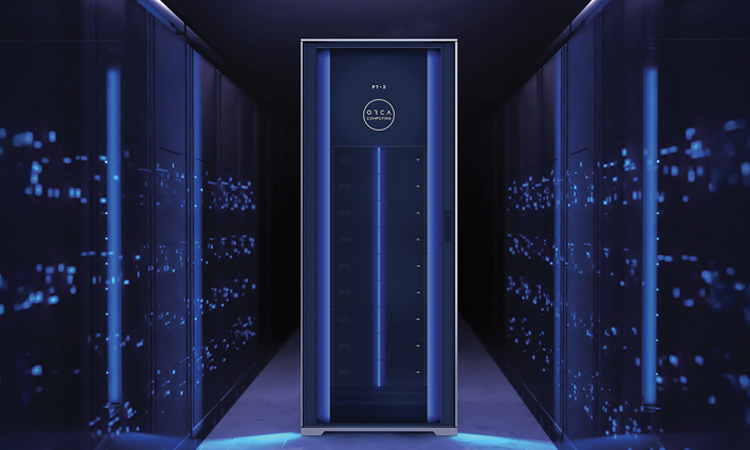 ORCA Computing has recently launched its PT-2 photonic quantum computer. [ORCA Computing]
For decades, photonic systems have provided physicists with a rich playground for exploring fundamental quantum phenomena, from understanding the ambiguous nature of wave–particle duality to pioneering experiments in the late 20th century that proved that quantum information could be shared between particles through entanglement. That foundational work has enabled scientists to harness such esoteric behavior in practical systems that have delivered unprecedented capabilities in sensing, imaging and ultrasecure communications. Now, a growing number of startup companies are convinced that photonic systems will become the star player in the emerging world of quantum computing.
A growing number of startup companies are convinced that photonic systems will become the star player in the emerging world of quantum computing.
Some of these early-stage enterprises have already launched commercial photonic processors that can boost the performance of classical computers for specific computational tasks, particularly those that depend on machine learning and artificial intelligence. But there is a growing consensus within the photonics community that the long-held dream of demonstrating a universal quantum computer that can solve real-world problems more effectively than classical machines is finally within reach.
One of the companies striving toward that goal is PsiQuantum, which since its founding in 2016 in Palo Alto, CA, USA, has raised investor funding of more than US$700 million, along with significant government support in the United States and Australia, to build a photonic quantum computer with a million qubits. It has been working in partnership with top-tier chip manufacturer Global Foundries to implement an architecture based on photonic integrated circuits and is confident that it will deliver a utility-scale quantum computer by the end of 2027. Canadian startup Xanadu has also demonstrated a prototype that integrates all the key elements needed for a universal photonic quantum computer, and it has charted a clear path for building a large-scale machine before the end of the decade.
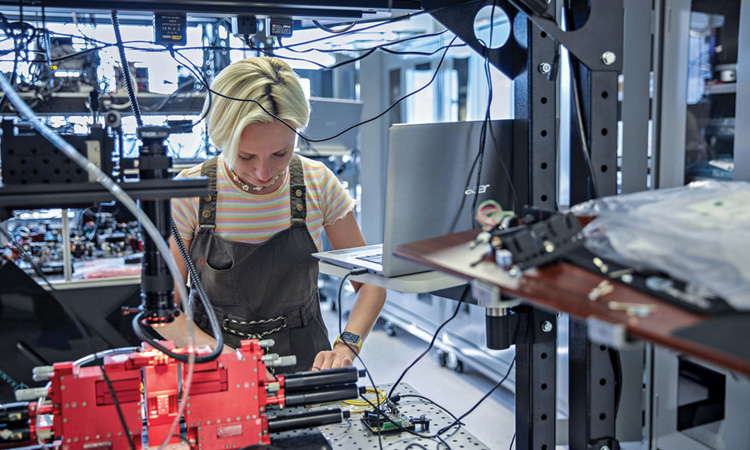 A researcher at work in Xanadu’s lab. [Xanadu]
If those predicted timescales prove true, photonic systems have the potential to leapfrog other qubit modalities that have demonstrated early successes but must now tackle significant scaling challenges. One advantage of photons is that they do not easily lose their quantum state due to heat or electromagnetic noise, which avoids the need to isolate the quantum processor within a cryogenic system or a vacuum chamber. Optical fiber also provides a ready-made solution for sending quantum information from one location to another, supplying easy connectivity between components and allowing multiple modules and processors to be networked together.
“The only way to create a large-scale quantum computer is through a distributed approach where multiple units are connected together, just as you would in a conventional data center,” says PsiQuantum cofounder and chief technology officer Mark Thompson. “Optical fiber is the most efficient way to transmit information between chips and between modules, and that’s why photonic quantum computing is so compelling.”
Photonics fundamentals
In many ways, photons offer the ideal physical resource for a quantum processor. The qubits that provide the fundamental unit of quantum information can be encoded in two different optical modes, such as the polarization or spin of a single photon, or even the spatial location of the photon within two distinct waveguides. These “flying qubits” retain their quantum information as they are routed around a processor, providing the long-lived quantum states that are needed to reach the end of a lengthy computation. What’s more, hardware developers have access to the wealth of technologies that have been perfected by the global photonics industry, as well as plenty of expertise in optical engineering to fashion new and innovative solutions.
Photonics and Quantum Computing: A Radiant Revolution

Photonics is critical in advancing the field of quantum computing because of the synergistic relationship between quantum physics and photonics. The result is a transformative effect where photonics utilizes the distinctive characteristics of quantum states, including superposition and entanglement, to facilitate quantum information processing. The technical intricacies of photonic qubits showcase their potential to outperform classical computers in specific tasks.
Arshey Patadia is a product manager with Laser Components Detector Group Inc. and has more than 12 years of engineering and technology experience, which has been marked by four patents and more than 20 publications. He has designed and developed silicon, germanium, and InGaAs-based photodetectors that improve navigation and obstacle detection, as well as III-V-based PIN detectors that allow for precision gas sensing. In this Q&A, Patadia offers insights into the revolution of photonics in quantum computing.
Q: In what ways have photonics evolved in recent years?
Patadia: Photonics is still a relatively small industry compared to others, like artificial intelligence (AI) and machine learning (ML), because of the specialization this field requires and market dynamics. Miniaturization has been one of the biggest challenges to overcome, yet photonics-based tech products and systems have been steadily shrinking—albeit not as fast as CMOS-based chips. This is called SWaP-C, which stands for smaller size, lighter weight, more power, and doing it at a cheaper cost. There’s always pressure to make increasingly smaller computer chips since chip manufacturers use Moore’s Law as a guiding principle. I believe the photonics industry can ride that wave.
Q: What makes quantum computing important, and what are its key applications?
Patadia: Essentially, the processing speed and problem-solving abilities make this technology paramount. Quantum computers can perform tasks in just 36 microseconds—a fraction of the 9,000 years required by current supercomputers for the same type of task load. To put it in perspective, a Boolean logic computer that understands only two states, true and false, took decades to complete—the same task a Google quantum computer processed in mere seconds. This breakthrough can redefine computational limits for applications that revolve around time, such as GPS, security applications like cryptography, and the medical industry, where it enhances research, simulates biological processes, develops treatments, and more.
Q: How do the photonics and quantum computing landscapes intersect?
More: https://www.computer.org/publications/tech-news/trends/photonics-and-quantum-computing-revolution
Photonic Quantum Computing
Jacquiline Romero, Gerard Milburn
Photonic quantum computation refers to quantum computation that uses photons as the physical system for doing the quantum computation. Photons are ideal quantum systems because they operate at room temperature, and photonic technologies are relatively mature. The field is largely divided between discrete- and continuous-variable photonic quantum computation. In discrete-variable (DV) photonic quantum computation, quantum information is represented by one or more modal properties (e.g. polarization) that take on distinct values from a finite set. Quantum information is processed via operations on these modal properties and eventually measured using single photon detectors. In continuous-variable (CV) photonic quantum computation, quantum information is represented by properties of the electromagnetic field that take on any value in an interval (e.g. position). The electromagnetic field is transformed via Gaussian and non-Gaussian operations, and then detected via homodyne detection. Both CV and DV photonic quantum computation have been realized experimentally and they each have a unique set of challenges that need to be overcome to achieve scalable photonic universal quantum computation. This article is an introduction to photonic quantum computing, charting its development from the early days of linear optical quantum computing to recent developments in quantum machine learning.